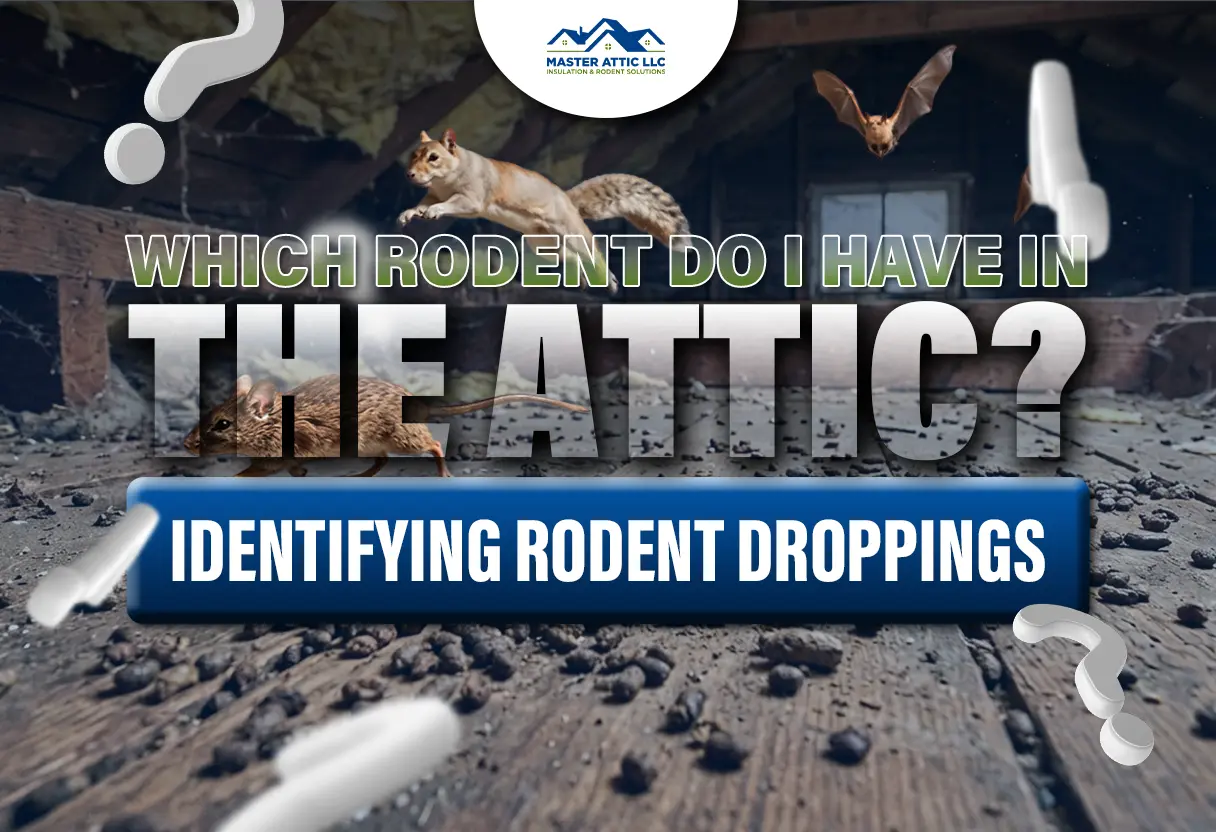
Which Rodent Do I Have In The Attic? - Identifying Rodent Droppings
EEEE! There’s Rodent Droppings In The Attic!
In today's article, we will help homeowners understand the differences between those 'attic droppings' left by nature's wild animals who 'drop in.'
As every 'cute' feathered or furry creature of nature has distinctive characteristics that identify who they are - the bandit-masked face of the raccoon, the black wings of a bat certainly different from the wings of a sparrow, the red breast of a robin, and it’s easy to spot a skinny mouse or rat tail versus the fluffed tail of a squirrel or chipmunk - but EEEE! As a homeowner, you might not be able to answer 'who left those droppings' discovered scattered on floorboards or between the beams of the attic insulation. Those 'droppings' are also 'diSTINK tive' - but definitely NOT 'cute.'
Why Are There Rodent Droppings In The Attic?
To put it another way, 'what's the scoop on the poop?' Concisely, rodent droppings are a sign of an active attic pest infestation! The attic pest infestation, and thus their ‘droppings,’ occurs when squirrels, raccoons, or rats use overhanging tree branches for access to the house roof. Raccoons, with their finger-like claws, use the textured shingles of a home to climb upward. It only takes a foundation gap 1/4-inch for mice to gain entry to the house; for a rat, the gap is the size of a quarter. Bats can slip through a gap as narrow as a pencil.
In a previous article, Why Do I Hear Something Moving In My Attic?, the 'rumbles from the rafters' heard from above the homeowner, settling into the comfort of a recliner or sofa, was that of gnawing, scurrying, scratching, scuffling, fluttering, or loud thumping of the wild animals who discovered the warmth of the attic space. In the article Why Do Animals Like Attics? details were given of the usual animals: squirrels, raccoons, bats, rodents, and birds found in the attic space and why they like attic spaces to the 'great outdoors.' Now we, the pros who know 'all things attic,' with 20+ years of experience in attic and crawlspace restoration and rodent solutions, explain: why are there rodent droppings in the attic? In a recent article, When Are Attic Pests Most Active? we gave the reason for attic pest activity in every season!
How To Identify The Rodent By Its Droppings?
Attic pest droppings can all be identified by the ‘diSTINKtive size, shape, and pattern of the ‘droppings’ left in the attic insulation nest, floorboards, or within attic soffit or beams:
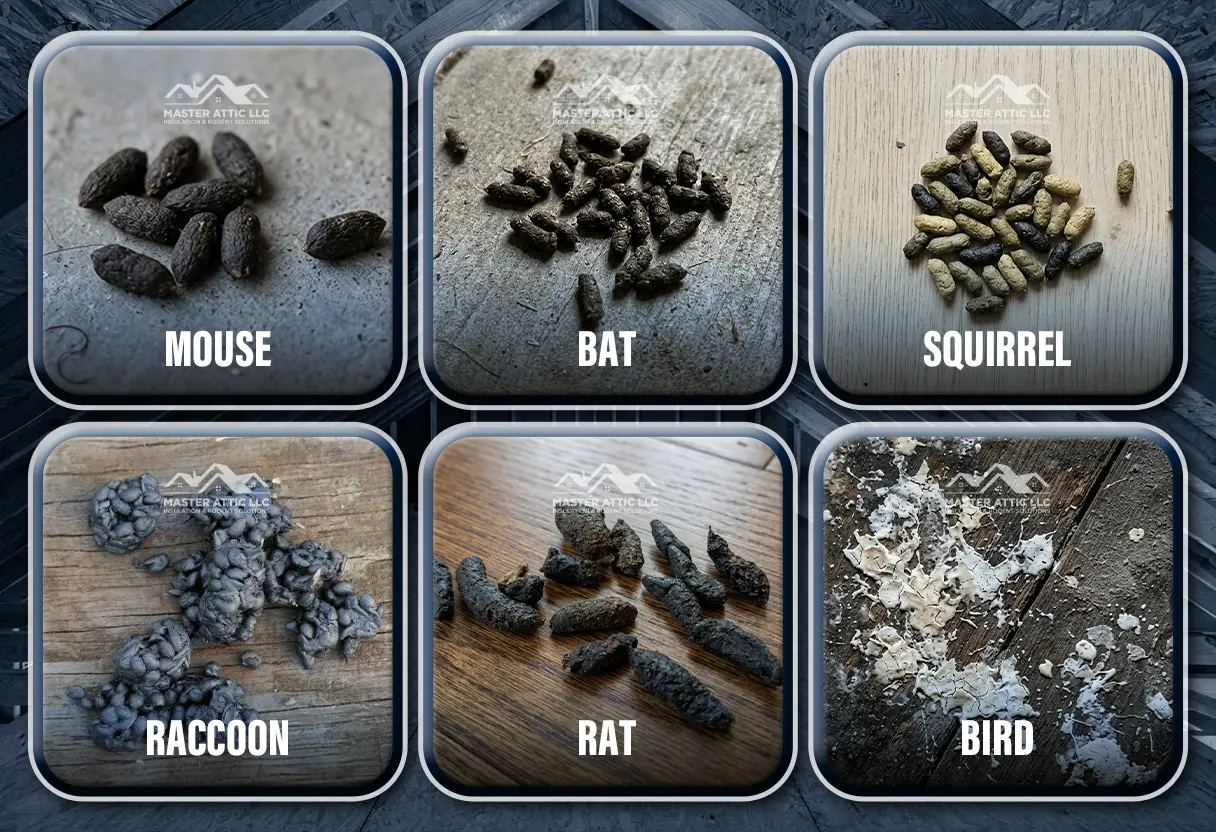
Mice Droppings: One mouse can leave up to 80 mouse droppings every day! Mice droppings are moist and soft when ‘fresh’ and are the size of a grain of rice and often black in color.
Rat Droppings: Significantly larger in size than mouse droppings, about the size of a green pea or small jelly bean and dark brown in color.
Squirrel Droppings: The 'droppings' of a squirrel can resemble those of rat droppings, in terms of size and color (dark brown). The main difference between squirrel 'poop' and rat ‘poop' is the size. Squirrel 'droppings' are very smooth and barrel-shaped, while rat feces are small and oblong pellet-shaped with tapered ends.
Chipmunk Droppings: Finding chipmunk droppings in the attic is rare, since chipmunks are prone to nest in underground burrows with specific latrine chambers. Droppings from chipmunks are approximately 1/4 to 3/8 inches in length, just slightly larger than mouse droppings, and have the same oblong pellet shape as a mouse, tapered at the end, and the same black or dark brown color as the mouse droppings.
Raccoon Droppings: The pattern of raccoon droppings is that of repeated piles rather than scattered droppings. The droppings are tubular, two or three inches long, and medium-sized, similar to dog feces. One distinctive trait of raccoon droppings is that they are visibly filled with seeds, undigested berries, or corn husks. Raccoon droppings have a very pungent odor, worse than dog or cat feces.
Bird Droppings: The droppings of a bird are well-known, especially to those who just got the car washed and suddenly find a large 'splash of a white/brown patch' on the car roof or windshield. In attics, bird 'messes' can be found directly under broken attic vents, in large heaps under and around physical nests, splattered or matted in the upper layers of the attic insulation, or as whitish-grey streaks and splashes dried onto attic wood framing, trusses, and structural ledges.
Bat Droppings: Bat droppings, also known as guano, are a combination of feces and urine; they are oval-shaped with very rounded ends, with the pattern of being glittery and shiny.
Why Are Rodent Droppings In Attic Dangerous?
EEEE! One danger of an active attic pest infestation concerns the 'droppings,' which can transmit viral, parasitic, and bacterial diseases such as:
Hantavirus: The hantavirus can be a life-threatening virus that spreads through the ‘droppings’ and urine of rats and mice.
Histoplasmosis: A fungal infection that is contracted through breathing in bat and bird droppings. When the spores become airborne during cleanup and are breathed in, early symptoms such as fever, chills, headache, muscle aches, dry cough, tiredness, and chest pain can appear.
Roundworms: Roundworms are a parasitic infection, and breathing in the dried droppings of raccoons is of especially important concern, as the droppings carry microscopic eggs of the raccoon roundworm. When the raccoon droppings are disturbed during removal, dust particles and spores can be accidentally inhaled or swallowed. Roundworm larvae may hatch and migrate through body tissues, causing severe health conditions.
Leptospirosis: A bacterial infection transmitted through rodent urine. It initially starts with flu-like symptoms; if the illness progresses, liver damage and meningitis may develop.
Salmonella: The bacterial infection called Salmonella is carried by rodents in their digestive tract and deposited throughout the attic by rodent droppings. Salmonella causes an infection known as salmonellosis, causing stomach pain, fever, vomiting, and diarrhea.
If these viral diseases and bacterial pathogens that animal feces hold are not enough to scare, there is also the danger that comes when the animal ‘droppings’ dry up and the ‘dust particles’ become airborne, compromising the home’s indoor air quality.
Active animal infestation and inevitable rodent and wild-animal droppings can also deteriorate the home structure through rodent urine- and feces-saturated insulation. This saturation degrades the effectiveness of the R-value of thermal resistance to the insulation, raising the cost of keeping a home warm in winter and cool in summer. Rodent ‘droppings’ can also affect the home structure due to the moisture accumulation that soaks into wooden beams and drywall, causing wood decay and rot, as well as fungal mold growth that ‘feeds’ on organic waste.
Why DIY Removal Will Not Resolve Rodent Droppings?
NEVER attempt to resolve cleanup of rodent droppings as a DIY project! As detailed above, attempting to vacuum or sweep up 'rodent droppings' will only stir up the dried dust particles of the droppings, which can be inhaled by members of the household, resulting in contracting the viral, parasitic, or bacterial pathogens carried by the attic inhabitants: mice, rats, bats, squirrels, raccoons, or birds!
Sweeping or vacuuming up the rodent waste is only part of the resolution of the problem. It does not address the cause of the droppings, which is the active attic pests that carry ticks and fleas. Cleaning up animal waste involves disinfecting and sanitizing the attic space.
The abundant and guaranteed pest sprays of extermination are also an exercise in futility, as was detailed in the article, What To Place In Attic For Rodent Removal. If not putting in place the exclusion strategies of searching for and sealing all entry points of the rodents, the only guarantee one can count on is the guarantee of a return of the attic rodent who ‘spreads the word of the cozy attic warmth.’
Homeowners randomly placing a few mouse, rat, and rodent traps may catch one or two rodents, but will not resolve the infestation of mice and their 'tiny droppings.' Rodents are not so dumb; they quickly learn how to navigate around traps. The scent of rodent urine and feces, as well as the scent called pheromones, provides the cue to their 'friends' that this cozy space is safe territory, and the infestation problem, as well as 'droppings,' continues to grow.
Professional Removal Of Rodent Droppings
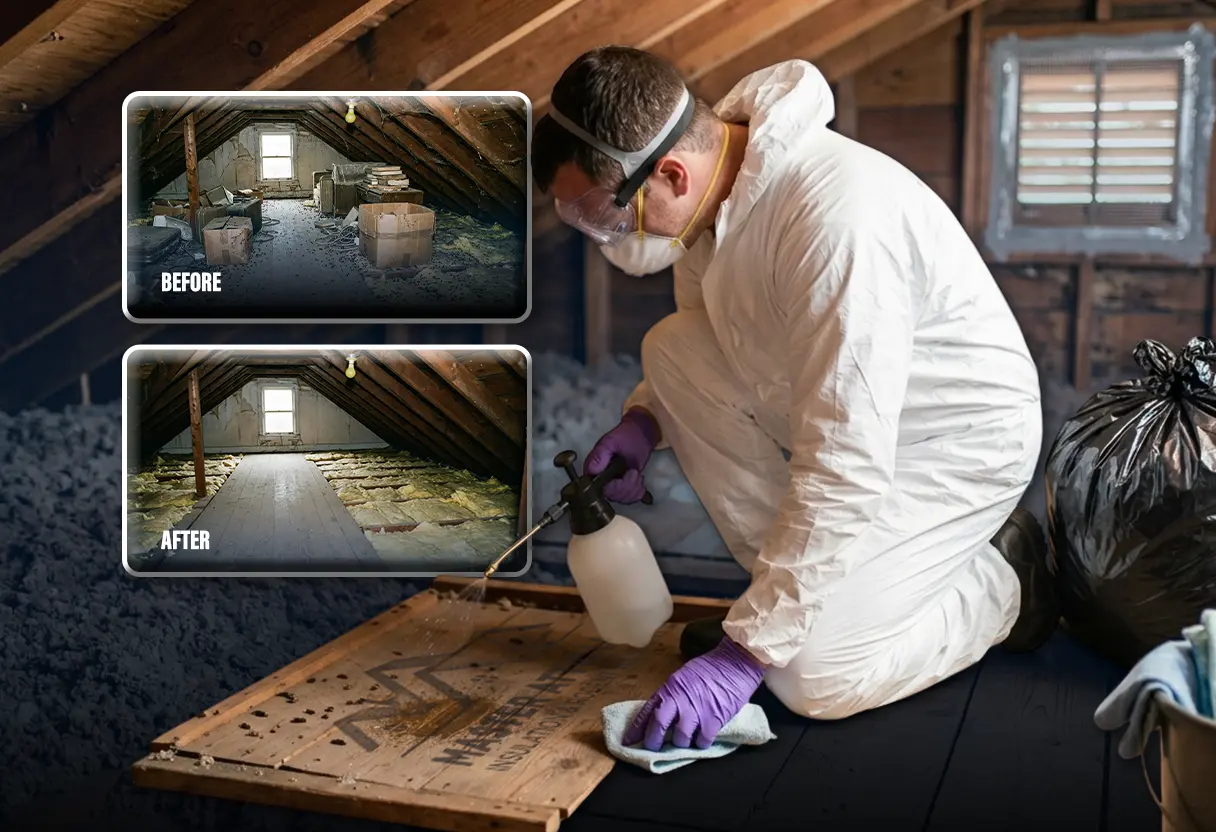
With the entry points sealed and any active rodents in the attic removed, the professional process of cleaning up the rodent or pest ‘droppings’ includes:
Ensuring Adequate Ventilation: Windows and doors will be opened for at least 30 minutes to air out the attic before beginning the cleanup work.
Wearing Proper Protective Gear: Rubber or plastic gloves, safety goggles, and an N95 or HEPA-rated respirator mask.
Wet Cleaning Method: The trained professional always chooses 'wet cleaning' by spraying the droppings, urine, and nesting materials with commercial disinfectant and bleach solution, preventing the dry 'droppings' from blowing through the air.
Allowing Disinfectant Time: The disinfectant needs to sit for five to 10 minutes to kill bacteria and viruses before the professional contractor will wipe and pick up the wet droppings and nests with paper towels and place the droppings into a sealed plastic trash bag.
Sanitize: The final and most important step in the removal of rodent droppings is the cleaning, sanitizing, and deodorizing of the attic.
The Professional ‘EEE Process’ To Rodent Proofing Of Attic
The only way to remove rodent droppings is to remove the source of the droppings - which is the rodent! That requires hiring pros who know the rodent proofing process. Think of the process as the professional EEE!
Examination of the home from the foundation to the roof edge, soffits, fascia, and gable vents for even the tiniest gap that allows a rodent entry.
Elimination of the rodents in the attic before sealing the entry points.
Exclusion by sealing off all gaps with galvanized or stainless-steel mesh and filling gaps around pipes and electrical wiring with a heavy-duty sealant or fill fabric material.
The attic professionals of Master Attic understand ‘the nature of the beast’ and utilize a methodical process to set traps, or poison if necessary, to capture attic pests:
In our article How To Get Rid Of Rats In The Attic - FAST!, it was explained that rats are known to be neophobic, which means very cautious of new objects in their line of travel. The DIY trap method of placing one or two traps on the attic floor will never capture one’s prey! Master Attic techs 'outsmart' neophobic rats by pre-baiting the trap without setting it to snap so the rat gets used to the trap.
The attic professionals of Master Attic also understand how to determine the path pattern of mice, or rats, by examining for sebum, aka grease marks, the rodents leave on attic joists and rafters. The nursery rhyme titled “Three Blind Mice” is indeed true; mice have poor vision and so follow along walls to guide their path and do not deviate from an established path. When seeing the sebum, traps are strategically laid along the rodent’s runway to ensure capture. The homeowner who sweeps up the attic droppings only causes the active attic pest to ‘relocate’ the nest, which changes their path of travel.
The initial examination of entry points of attic pests tells Master Attic professionals the type of pest living up in the attic rafters, what type and size trap to set, and the best bait to use. Homeowners' DIY approach of putting down poison to kill attic pests can backfire when the rodent retreats inside a wall to die, leaving an odor that can release dangerous pathogens into the home for weeks, along with an unreachable carcass. Poison that kills some rodents in the attic will not stop others from coming in - if the entry point is not professionally sealed.
For all the above reasons, DIY removal of ‘attic droppings’ should NEVER be a DIY project! It is always best to call established professionals for attic cleaning, sanitizing, and full restoration!
Contact
Master Attic technicians are the go-to pros who ensure attics are fully restored through attic sanitizing and removal of contaminated insulation caused by animals living in your attic, as well as providing installation of new insulation. Master Attic also understands the importance of rodent-proofing the attic by identifying and sealing off entry points. Don’t wait, contact Master Attic via our website form or EEEE-mail us at info@masterattic.com. Time is of the essence for your family's health and your home's structural integrity!