
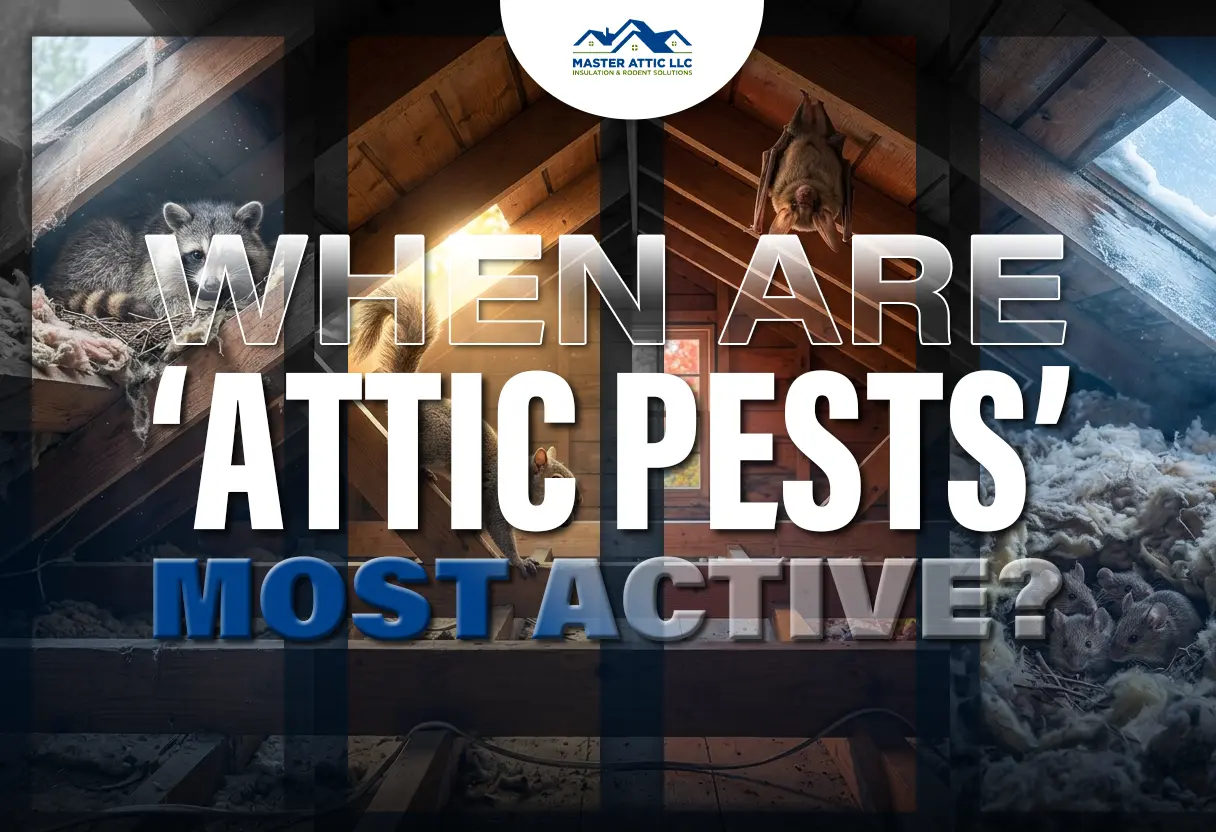
When Are ‘Attic Pests’ Most Active?
Many homeowners wonder which attic pests are most active during specific seasons. Understanding when pests like raccoons, squirrels, or bats are most active can help homeowners feel more prepared and confident in their vigilance and planning.
Table of Contents
Why Are Animals In The Attic?
In a previous article, Why Do Animals Like Attics?, we gave reasons why the beasts of the wild as raccoons, tree squirrels, and ground squirrels known as chipmunks, mice and rats, birds, and bats leave their great outdoors for the indoor comfort of a homeowner’s attic. While homeowners may feel the angst of hearing the thumping, scurrying, scratching, chirping, scuffling, gnawing, squeaking, and fluttering, these ‘cute, wide-eyed’ creatures of the wild are content to have found warm shelter, protection from their predators, a peaceful nest to breed and raise their young, and ‘from their perspective’ easy entry to come and go following their natural nocturnal (nighttime) or diurnal (daytime) survival instinct to find water, and to forage for food — to bring back to their ‘comfortable’ attic nest! This animal behavioral instinct is as important as the question of why animals like attics, in helping ease the homeowner’s apprehension and anxiety.
What Are The Seasons When Attic Pests Are Most Active?
Attic ‘pests’ intuitively follow seasonal wildlife behavior patterns in winter, spring, summer, and autumn.
Understanding the wildlife activity is key to preventing animals from taking up residence in the attic.
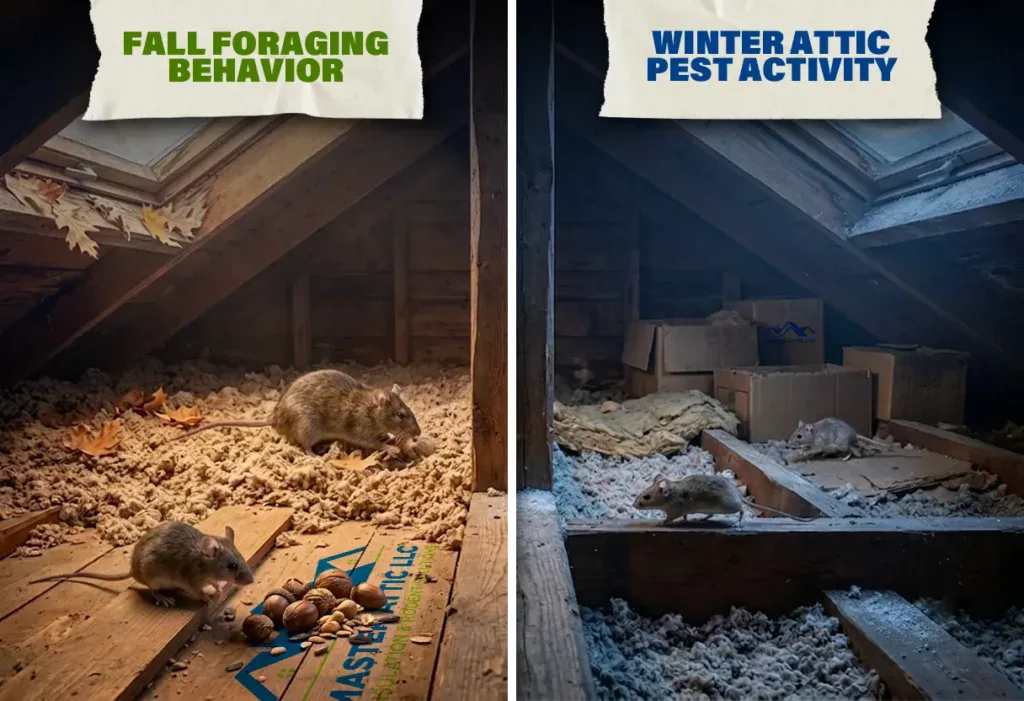
Autumn: Autumn is the time eastern tree squirrels can be seen energetically scurrying, with a purpose called food caching! These eastern squirrels dig thousands of shallow holes to bury hard-shelled nuts, as acorns or seeds, which allow eastern squirrels to remain active during winter, rather than go into a hibernating sleep.
The winter survival habit of the tree squirrel is to build ‘dreys,’ a sturdy basket-like nest in the forked branches high up in a tall tree, or in the holes within trees, or in the elevated safety of the attic space, should they find a way inside!
In the attic space, the eastern tree squirrel can be active during the day, scratching at the insulation to build its nest and arranging its food cache.
Ground squirrels, also known as chipmunks, are active in building a food cache in autumn to adapt to incoming cold weather. On autumn mornings, the chipmunks are especially active, frantically foraging and stockpiling
non-perishable berries, nuts, and seeds in their underground burrows, with activity peaking mid-morning through late afternoon. The chipmunk food cache is placed in a separate area within the underground burrow, but not far from their winter nest.
Winter: In the cold of winter, some wildlife settles in for a long winter nap, known as hibernation, with the duration of hibernation varying in accord with regional climate, species, and food availability. The eastern tree squirrel does not hibernate in winter, but will seek out the food caches they buried in the ground or brought into the attic. The homeowner is likely to hear the active antics of the eastern squirrel in the attic during the day: rolling acorns, rustling leaves in the eaves, tearing at attic insulation, cracking open acorns or other hard-shelled nuts, and scampering about the attic floor! In contrast, eastern chipmunks partially hibernate in their underground burrows, entering a state of sleep known as torpor, waking every few days to eat from their abundant food caches built in autumn.
Another common active ‘attic pest’ that does not hibernate is the nocturnal mouse, or ‘shudder’ mice or rats — winter breeding of one or more female mice or rats can multiply rapidly. Attic ‘animal pests’ such as mice and rats are most active in the winter months, scratching and scurrying across the floor.
For the nocturnal raccoons, the warmth of the attic is a heavenly ‘temptation,’ especially if outside food sources are scarce. The nocturnal raccoons also enter into a torpor sleep, but can become aroused quickly. Homeowners may occasionally hear raccoon activity in the attic in winter, as the animals thump, scratch, and shuffle.
Bats entering the attic space in winter are rarely seen flying in and out for food at night, as food is scarce. The bat or bats have a complete winter dormancy known as torpor sleep, be it a cave or the attic!
Spring: Spring, and not winter, is the season when ‘attic pests’ are most active! — spring, the season of re-birth, when the trees are budding, the flower gardens and grass are growing again, insects are more active, homeowners plant vegetable gardens and put seed in bird feeders to greet the returning feathered friends as robins, starlings, and sparrows! Spring is also the time for mating and the birth of many animal pests within an attic nest.
Female raccoons wake from their torpor state of sleep in the attic winter nest as warm temperatures and food are more readily available in spring. Raccoons will be more active in and out of the attic through attic vents and soffits, and along previously gnawed rooflines during the day to hunt for food and regain the weight lost during the winter torpor. At night, there will be increased thumping, scuffling, and scratching, and a low mewing of the new young.
Squirrel activity in the attic is also greater for the same reasons: breeding and nesting season, and the building of nests in the elevated attic soffits or vents; or they manage to get inside and make a nest in the soft attic insulation.
Spring brings the attic bats to their normal activity of flying in and out of the attic at dusk in search of food and returning to their roost at dawn — female bats using the attic warmth as an incubator for forming nursing colonies (shudder).
The birds of spring are also most active in the attic, because spring is also their nesting and breeding season! An attic space provides warm protection from predators to themselves and the eggs they lay. Activities include parent birds flying in and out of the attic space to bring food back to their young, as well as adding twigs, grass, and moss to the nest to keep their young comfortable. Activity can be frantic, with the wings fluttering and flapping to ward off predators near the roofline.
Summer: Summer activity of raccoons, mice, rats, and bats is also when ‘attic pests’ are most active! Spring is the breeding and nesting time; early summer is for raising the young in preparation for seasonal wildlife survival behavior. Diurnal (day) animals or nocturnal (night) animals stay in the attic in summer for the same reason they take up residence in winter, as an escape from extreme weather temperatures: winter cold, or summer extreme heat, and extreme summer storms with heavy rain. The attic activity in summer is similar to spring: rustling, scampering, scurrying of diurnal eastern squirrels early morning or late afternoon, heavy thumping, scratching, pitter-pattering, and scampering or chattering at night by nocturnal raccoons, mice, rats, or bats.
What Are Common ‘Attic Pests?’
We call the otherwise furry and feathered ‘friends’ of nature ‘pests’ because of what they ‘innocently’ can do up amidst attic eaves, consisting of: soffits: The flat paneling beneath the overhanging roof, usually containing vents to allow cool fresh air to enter the attic, fascia: The vertical board capping the end of the roof rafters (beams), and rafter tails: the exposed ends of the roof framing, aka ‘beams’ that extend past the wall.
As we explained the seasons when ‘attic pests’ are most active, it’s helpful to understand their habits, detect and prevent damage early.
- Rats and Mice: The teeth of rats and mice continually grow, and instinctively they keep them trimmed by gnawing on wood beams, walls, plastic pipes, and electrical wiring. They build nests by shredding the soft attic insulation. Rat and mouse ‘droppings’ and urine soak the insulation or ceiling drywall, which contaminates the air quality of the entire house, making the household susceptible to a variety of diseases, as mentioned in a previous article, How To Get Rid Of Rats In the Attic — FAST!
- Squirrels and Chipmunks: Squirrels will chew a hole through a fascia board or the roof shingles to gain entry to the attic, and will gnaw at the house framing support of attic beams. Squirrels, like any rodent, will chew anything — including electrical wiring! If a squirrel feels threatened, it will bite; however, it does not transmit rabies to humans, because if it does contract rabies from a predator, it is unlikely to survive. Rabies or not, a squirrel is very much territorial and will be aggressive if they feel threatened, to protect their young in their attic nest!
- Raccoons: Adult raccoons weigh approximately 25 to 30 pounds and can trample and compress attic insulation very quickly, and tear it up to build nests. Their sharp claws can easily rip through roof shingles, attic walls, vents, and soffits to gain entry. No question, the masked-faced ‘bandit-image’ of a raccoon in the attic will definitely steal the structural integrity of a home! The feces, pose health risk of roundworm eggs which can damage the human nervous system and raccoon urine, usually specific to one area of the attic,
- Bats: Bats in the attic cause a different form of attic destruction than rats, mice, squirrels, and raccoons. Bat ‘droppings’ called guano are very corrosive; any material it comes into contact with will become unstable, soft, and wet, and begin to disintegrate, such as floors, walls, or ceilings. Guano is responsible for the disease known as Histoplasmosis. The bat is known to transmit many viral, bacterial, and fungal diseases to animals (such as household dogs or cats) or to humans.
- Birds: A bird nest built into soffits, roof vents, and exhaust pipes can block natural airflow, leading to a build-up of moisture, followed by wood rot and the toxicity of mold growth. Bird droppings contain a high concentration of uric acid, which can degrade and eventually erode roof tar paper and metal flashing around chimneys. The removal of a bird or a bird nest requires professional knowledge of federal law, known as the Migratory Bird Treaty Act. New Jersey and Pennsylvania state regulations protect certain species during nesting season, and removing a bird or an active bird nest requires a special permit.
Why Is The Torpor State Used By Animals?
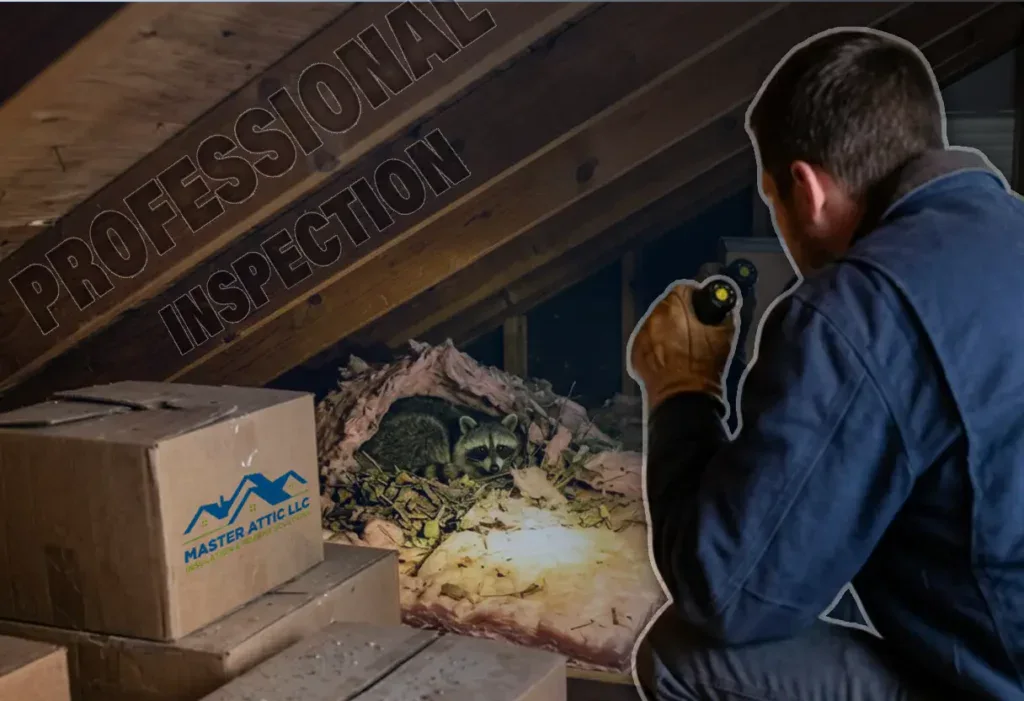
Homeowners who enter their attic and see any animal, completely motionless, should NOT venture to get a closer look, assuming that animal stillness is safe. There are varied reasons for animals in the attic going into a stillness, or torpor state, that may appear as an animal being dead, or in sleep hibernation; when in fact the wild animal is:
- Protecting Themselves: Animals instinctively know how to ‘play dead’ if they suspect ‘danger.’ Animals, such as bats, mice, skunks, tree squirrels, and ground squirrels (aka chipmunks), or small birds, may be in a state of torpor, which differs from true hibernation; animals in a state of torpor have a decreased metabolic rate, body temperature, and physical activity. An animal in hibernation will not be awakened by loud noises, footsteps, or being moved or touched. Animals in a torpor state are still responsive to their surroundings, and approaching them can awaken them and make them aggressive toward what they perceive as a predator to their safe haven.
- Protecting A Nest: Animal ‘stillness’ does not equal safety for the homeowner who spots two eyes staring back from the insulation. Female raccoons are extremely protective of her young in the attic insulation nest and will become aggressive if they see anything approaching their nest — animal or a human. Squirrels also will ‘stare down’ the homeowner, remaining still, but guarded, of her litter of ‘pups.’ Such birds as sparrows and starlings will ‘freeze’ while watching the homeowner enter the attic space, then make a QUICK dive-bomb at what they see as an aggressor to their nestlings or eggs in the attic.
- Winter Survival Habit: As stated, wild animals have a natural behavioral instinct to find water and forage for food during winter. In the colder winter months, rather than leave the cozy, warm, and safe environment they found in the attic, and needlessly burn more calories than the minimal insects, berries, and nuts found would provide, an animal’s body involuntarily shuts down non-essential functions, lowering metabolism, heart rate, breathing, and entering into a winter dormancy or torpor state to survive without eating. This winter dormancy keeps them safely hidden in a sheltered area, while the torpor state ensures their energy reserves are not spent and their vital internal organs do not freeze.
For these reasons, homeowners need to listen well when asking, ‘Why do I hear something moving in my attic?
What is heard should be described to the licensed and experienced professionals of rodent removal and rodent proofing, experienced in seasonal wildlife behavior of stillness or activity. Homeowners should NEVER enter the attic if one suspects animal activity!
Contact
Winter, spring, summer, or autumn, the licensed, insured, technicians of Master Attic have been actively providing NJ and Pennsylvania residents with attic and crawlspace solutions for 25+ years! Master Attic delights in providing NJ and Pennsylvania residents understanding and solutions for seasonal wildlife behavior patterns. Contact us today with any questions or concerns about suspected animal activity in the attic.