
Why Do I Hear Something Moving In My Attic?
In our article Why Do Animals Like Attics? we discussed the noises homeowners may hear as they settle into the comfort of recliner or sofa: the ‘light’ sounds of gnawing, scurrying, scratching, scuffling. fluttering, or
chirping — even loud thumping. banging, or knocking! We provided the answer that such sounds are the result
of a furry or feathered ‘creature’ seeking warmth, safety, and a comfortable nesting environment!
No question, the sound of ‘rumbles from the rafters’ should not be ignored! However, do not be too quick to assume what the noise is. It could be the kids ‘exploring’ the dark mysterious space for ghosts and monsters, maybe it is one’s spouse hiding early holiday shopping gifts! There are many reasons one might hear something moving in the attic. Today’s article aims to take the mystery out of hearing movement in the attic.
Table of Contents
What Is That Attic Movement And Noise?
To help homeowners feel more confident in understanding attic movement and noises, listen carefully to the movement and sounds. Recognizing whether the noise is a mechanical issue or habitation by an animal can guide your next steps, making you feel more in control of the situation.
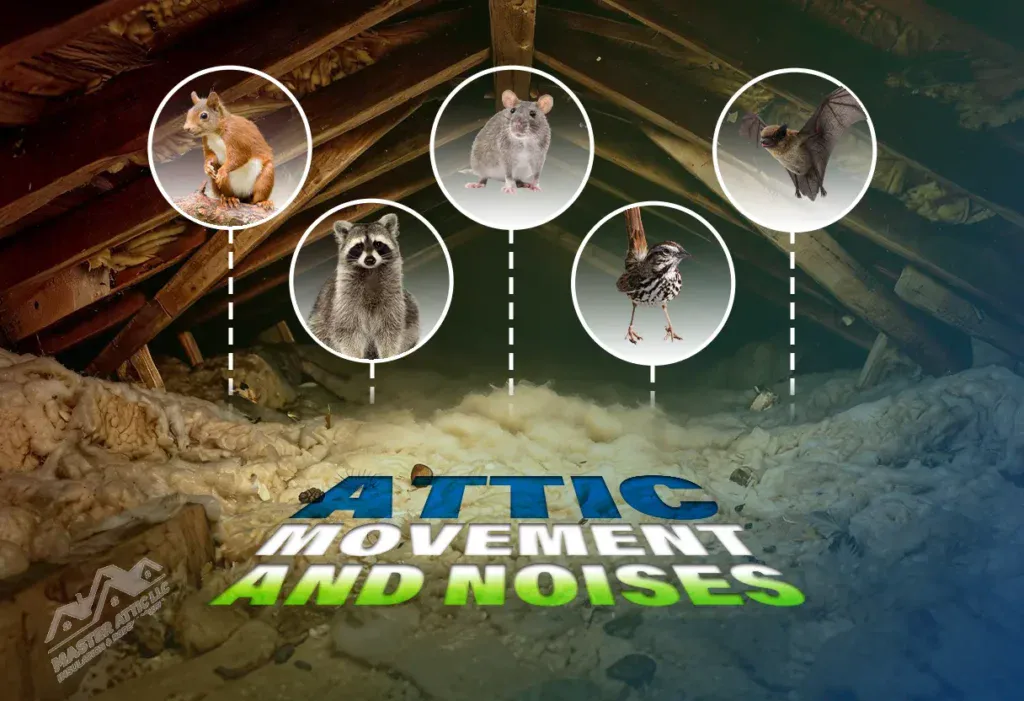
- Squirrels: A squirrel is a diurnal animal, which means its movements are active during the early morning, when it exits its warm attic home, and late evening when it enters the attic space. The movement of squirrels, part of the rodent family, in the attic would be a quick, light, rhythmic pitter-patter of tiny footsteps. The rhythmic pattern is that of tap, tap, scrape — and called scurrying! This scurrying pattern is a stop-and-go pattern: stopping to look for danger and then moving again. It is a ‘running sound.’ Being a light sound, it is heard best when the house is quiet. There can also be heard a rolling sound of the acorns and nuts squirrels bring back into their attic nest, and there will be a high-pitched chattering when ‘talking’ with other squirrels, a screech if alarmed, and a high-pitched chirping sound of a baby squirrel ‘talking’ with its mother. If there are many squirrels in the attic space, the light scurrying can sound like a gallop!
- Raccoons: As squirrels are diurnal, raccoons are nocturnal creatures, sometimes referred to as ‘bandits’ for the black around their eyes, similar to a mask. ‘Bandit’ may be an appropriate nickname, as their movement can be heard as a rustling sound, as if one were stirring up dry leaves or paper. Nocturnal as these creatures are, their movement is most active at dusk and dawn. At night, a homeowner may hear the movement of their long, ‘finger-like’ paws scratching the attic floors or scratching inside the walls — or the loud gnawing on roof shingles to get into their new home! A raccoon weighs approximately 20 pounds or more, and if in the attic, its movement will be heard with loud thumps and knocking as it jumps from one attic place to another and shoves items that get in its way, much as it shoves over trash cans when outside. A raccoon is known to make over 200 different sounds: purring, chittering, growling, snarling, hissing, whimpering, and screeching, like an owl. A baby raccoon will make soft mewing, crying, and whining.
- Mice and Rats: The movement of a mouse scampering or scurrying across the attic floor, behind baseboards, or along walls is often accompanied by a scratching sound as its nails dig into the surface to get a firm grip. A mouse’s vocalization is a high-pitched squeak, like a ‘singing’ chatter when searching for food, and it becomes louder when they find food. When mating, the squeaks are faster. The sound of a tiny mouse in the house is heard best at night, as a mouse is also a nocturnal creature, as well as crepuscular, with its movement being heard at twilight, dawn, and dusk! A mouse is a smart little creature that moves about in the attic while humans sleep. Homeowners may hear a ‘grinding type of gnawing’ sound. The movement of a rat in the attic space is like that of a mouse: their claws, like the mouse’s, dig into a surface to get a good grip as they scurry, scuffle, and scratch. Like the mouse, the rat is nocturnal and can be heard at dusk and night, searching for food. The rat is rarely heard vocally by the human ear, as rat sounds are ultrasonic. The movement of a rat in the attic is that of scratching, gnawing, and rustling along the floor of the attic or inside the walls. They chomp and grind their teeth.
- Birds: The movement of birds in the attic space will be heard as light, rapid scratching as they hop about and shuffle, and, of course, the sound of fluttering wings as a bird or birds enter or exit a small entry point. There can be vocal chirping or cooing at times. Bird movement will be heard during the day, as birds are also diurnal, like the squirrel, typically moving about at sunrise and sunset. If baby birds are present in a nest, there might be heard quiet, but continual, chirping. Describing the vocalization will help the contractor hired to remove the bird, as all birds have unique vocalizations. A starling, relative to the mynah bird, can warble, whistle, chatter, and make smooth liquid sounds or harsh trills and rattles, and if flocking together, make quite a loud vocal noise, while sparrows create lighter and more rapid sounds. Pigeons are known for their distinct cooing.
- Bats: Bats are another nocturnal animal that emits sounds, called echolocation, to navigate at night and hunt for food. These ultrasonic sounds are beyond the range of human hearing. They are heard vocally, emitting squeaks or chitters, usually between dusk and dawn. A baby bat can make a high-pitched chirp, similar to that of a bird, in summer, but you would have to be up in the attic to hear one bat. If there is a colony of young bats, shudder, the homeowner might hear their vocal sounds. The movement of a bat might be heard every night at dusk when they leave their cozy attic home to feed. The bat crawls to the bat exit hole, making its movement sound like scratching and scurrying. If bats are flying in the attic, the homeowner will hear flapping and fluttering. However, a bat can use its wings to climb and crawl, so it is possible the homeowner will hear scratching on walls.
Curiosity, Curiosity, it has been stated, can ‘kill the cat’ — referring to the natural inclination of a cat to climb and explore, which can bring the cat to get ‘stuck’ in tree limbs, a chimney, or any open but tight space. When homeowners hear movement and noises in the attic rafters, however, wise homeowners should be curious enough not to ignore the noise they suspect to be a wild animal and seek help from anattic professional! Do not be curious to peek up there alone! Those ‘cute creatures’ of the wild ARE WILD, especially if protecting their nest of young! As we explained in Why Do Animals Like Attics? Animals can carry parasitic diseases, such as fleas, ticks, and mites, or viral diseases, such as rabies. Remember it is: ‘I – Investigation, before EEEEEEE!‘ Call for an investigation by an attic professional!
What Are Other Sound Reasons For Attic Noise?
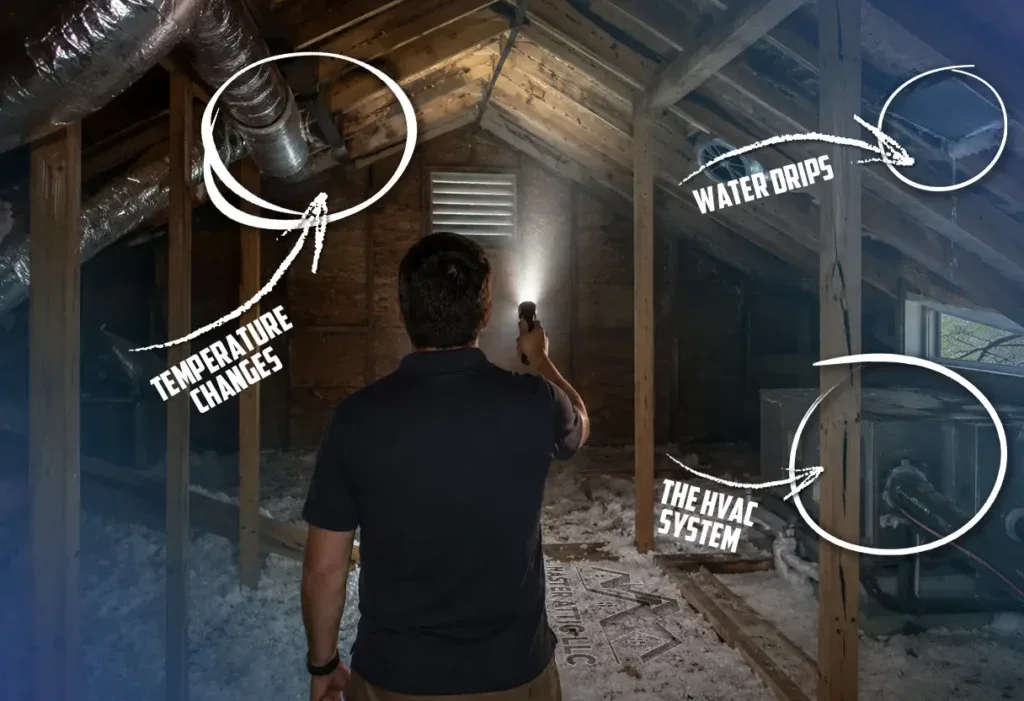
- Temperature Changes: This is known as thermal expansion. The attic can be quite hot during the day and cool at night, making the metal ductwork, chimney flashing, or attic vents give ‘popping’ sounds as they expand or contract with temperature swings.
- Wind Gusts: When the howling winds start to screech, the roof shingles can shake, creak, and bring loose cable vents to rattle!
- House Structure Settling: If a home is relatively new, the foundation of the home can shift, causing cracking sounds.
- The HVAC System: As air pressure changes in the home ducts, there comes a banging or rattling sound. A low humming sound can come from an attic fan, or if the HVAC air handler is in the attic, rumbling, clicking, or a low hum can be heard as it continually starts up.
- Tree Branches: If there is a tree close to the house, the overhanging branches can rub or tap against the roof when it is especially windy.
- Water Drips: If hearing the sound of water drips overhead, there could be a roof leak or a leaky pipe in the walls of the house. Water leaks can wreak havoc on attic insulation, necessitating its replacement.
Who You Going To Call When Attic Sounds Are Heard?
When the creak, crack, roar, or hum is heard in the attic space, one need not call the Ghostbusters, three scientists who start a ghost busting business in New York City using high-tech equipment, as told in a 1984 movie. Fear not! The movement heard in the attic is more than likely the result of:
- Nocturnal creatures finding a warm, safe, and comfortable place to nest their young. You need to call the trained technicians who can remove such creatures and rodent-proof your attic.
- Loose cable vents banging amidst strong wind gusts. You will need to call professionals who understand proper attic ventilation with the installation of baffle vents.
- Thermal expansion that brings the ‘popping’ sound of metal ducts, chimney flashing, or attic vents, as they expand or contract in shape due to temperature swings. You need only call the pros who know how to install the correct attic insulation.
- Improper flow of air pressure in home ducts. Who are you to call? Yes — you know the answer! You want to call the attic professionals who know how to clean, repair, or replace those dingy ducts!
- House structure settling and the foundation shifting do not require calling those ghostbusting BOOsters. More than likely, you would need the assistance of the professionals who understand that a well-maintained crawlspace or basement is essential to a structurally sound house.
Master Attic technicians are the pros to call for every attic or crawlspace difficulty! Trained in giving the eviction notice to raccoons, squirrels, mice, and bats, who like taking up residence in attics in New Jersey and Pennsylvania. In addition to rodent removal, Master Attic technicians ensure the attic is fully restored with attic sanitizing, removal of contaminated insulation caused by animals living in your attic, and installation of new insulation. Master Attic also understands the importance of rodent-proofing the attic by identifying and sealing off entry points. Don’t wait, Contact Master Attic, licensed attic and crawlspace professionals, serving New Jersey and Pennsylvania for 20 + years!