
How To Get Rid Of Chipmunks In The Attic?
The chipmunk — nature’s cute and tiny creature with puffy facial cheek pouches. Is this an animal to fear in the attic space? One reason the article on the animal sounds heard in the attic does not specifically mention the chipmunk is that chipmunks are part of the squirrel family and are sometimes called ground squirrels. The chipmunk can sound a bit like that of the squirrel scurrying and scratching! A chipmunk, however, is different, and the reason for this article is to explain their habits and habitation, and to answer the question: how to get rid of chipmunks in the attic?
Table of Contents
What Are The Habits And Ways Of Habitation Of Eastern Chipmunks?
- The eastern chipmunks are natives of both New Jersey and Pennsylvania woodlands, as well as spotted scurrying in rural and suburban backyards. The amount of chipmunk population of an area ranges from two to four per acre to as many as ten chipmunks per acre if there is sufficient food and ‘cover’ available. The adult chipmunk will only defend an area fifty feet around their burrow entrance; therefore, it is not surprising to find chipmunk ‘home burrows’ overlapping one another.
- The eastern chipmunk can be very vocal, releasing a sound as chuck-chuck-chuck.
- The eastern chipmunk is most active in the early morning and late afternoon.
- The adult chipmunk has a varied diet consisting of grains, nuts, berries, seeds, mushrooms, insects, and carrion (dead remains of animals). Chipmunks have also been known to prey on young birds and bird eggs.
- Chipmunks will cache or store their food in underground burrows. The burrows are well-hidden near stumps, or brush, bushes, wood piles, or near home foundations or garages. The entrance is approximately two inches in diameter and will not be surrounded by mounds of dirt, which would tip off predators to their home. The chipmunk will carry the dirt he digs for the burrow in his cheek pouches and scatter the dirt away from the burrow entrance.
- Within the burrow tunnel will be a chipmunk nesting chamber, one or two food storage tunnels, and side ‘pocket’ tunnels that connect to the main tunnel, along with separate escape tunnels.
- A chipmunk will mate twice a year, in early spring and early summer. After a 31-day gestation period, the female chipmunk gives birth to two to five young in April to May and August to October. Young chipmunks are sexually mature after one year, and adult chipmunks have a lifespan of up to three years in the wild. Chipmunks do not actually hibernate during the cold weather of autumn and winter; they do enter a period of inactivity during the winter months and rely on the food cache stored within their burrows. In Pennsylvania, chipmunks emerge from their burrows from late April through early May, but can be spotted as early as March during a brief breeding season.
Why Are Chipmunks (Sometimes) Found In Attics?
While mice, rats, and eastern grey squirrels are the more common creatures heard scurrying and scampering up in the attic, the eastern chipmunk’s reasons for seeking shelter in the attic are the same as any of nature’s ‘critters’:
- Safe Shelter: The tiny chipmunk weighs in at 2 to 5 ounces and is 8 to 12 inches long, which includes its 3-to 4-inch bushy tail. Chipmunks are solitary creatures and prefer life in underground burrows with a camouflaged entrance hole. Their underground tunnels can be 10 to 30 feet in length, where food is stored and nests are built. Due to their diminutive size, however, the chipmunk has many predators: owls, hawks, snakes, raccoons, foxes, cats, dogs, sometimes their own squirrel cousins — oh my! All predators are always willing to try to pounce on these creatures with chubby-cheeked pouches! So, while chipmunk burrows and tunnels are the norm, those sharp
‘finger-like’ claws that allow them to dig also allow them to grip rough tree bark and the textured surface of brick, stucco, wood, and gutters, and escape from their predators! Chipmunks can also gain entry to the house through the tiniest openings in the house foundation, under crawlspaces, or through dryer vents. - Food Access: Bird feeders that hang on tree branches near roof lines are an irresistible temptation for any hungry chipmunk and make for an easy jump for an agile chipmunk to reach the house roof. Once on the roof, their sharp teeth can gnaw through roof shingles, roof vents, and soffits.
- Warm Nesting Material: Once the chipmunk discovers the warm attic space and the warmth of attic cellulose insulation for nesting, they easily adapt to the elevated and safe attic from their ground burrow and tunnels.
What Are The Signs Of A Chipmunk Infestation In The Attic?
Look, up in the attic. . . is it. . . is it. . .is it an eastern squirrel or is it an eastern chipmunk? As stated, the squirrel and the chipmunk are both of the squirrel family. Upon actually seeing these rodents, the differences are notable: the tree squirrel can grow to be 16 to 20 inches long and weigh one and a half pounds, while the chipmunk, as previously stated, weighs in at 2 to 5 ounces and is 8 to 12 inches long, including the 3-to 4-inch bushy tail.
The signs of a chipmunk infestation in the attic space include:
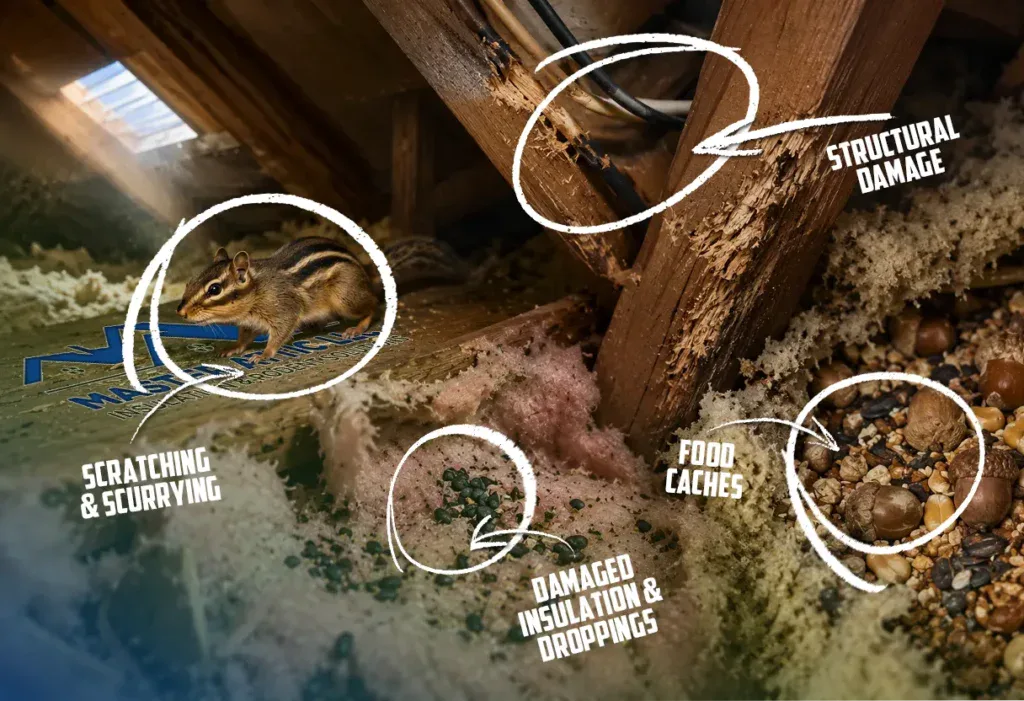
- Daytime Scratching and Scurrying: Chipmunks are diurnal creatures, which means their scratching and scurrying will be dominant in the early morning and late afternoon. The lightness of their body creates a rapid pattering footstep, rather than the heavier thumping steps of a weightier tree squirrel or raccoon. Amidst the scurrying and scampering, one might hear a high-pitched chirping or ‘chucking’ (clucking) sound. While mice or rats also scurry, mice and rats are heard in the dead of night, while chipmunk noises fade with the setting sun. The scratching of a chipmunk can sound aggressive, with their sharp claws scratching wood, walls, or insulation, in accordance with their natural nesting behavior of burrowing.
- Structural Damage: The omnivorous ‘tiny’ chipmunk has approximately twenty to twenty-two teeth, with two prominent incisors at the front of their mouth, one on top and one on the bottom of its mouth, that grow continuously throughout their life. So that these razor-sharp incisors do not overgrow, chipmunks naturally understand the need to gnaw on wood and nuts. If they did not gnaw, the teeth would curl back and puncture the roof of their mouth! Such prominent teeth are often used to gnaw at the soft roofline soffits, found under the eaves of the roof, and the fascia boards, which give them entry to the attic space and, consequently, also will open the attic to insects and other rodents, as well as cold drafts of air! A chipmunk chews anything to keep those ‘not really pearly whites’ sharp! The enamel on chipmunk incisors is fortified with iron, which gives these teeth extreme strength and durability and a distinctive rusty-orange color — all the better to chew the roof joists, attic support beams and rafters — which is no laughing matter! Such damage can reduce the roof’s load-bearing capacity. Chipmunks are not choosy about what they chew; they can chew electrical wiring running through or inside the attic walls, creating a fire hazard!
- Damaged Insulation: The powerful incisors of a chipmunk result in damage to attic insulation as they tear at the fiberglass and cellulose to build their nesting site, and subsequently destroy the insulation R-value, reducing a home’s energy efficiency. Chipmunk feces and urine will contaminate the attic insulation, bringing about a distinct,
pungent, ‘musty,’ and ‘slightly sweet’ unpleasant, concentrated odor, similar to the chemical smell of ammonia. Chipmunk feces are small, rice-sized pellets ranging in color from brown to black. - Food Caches: A sure sign of chipmunk infestation in the attic space is finding the food cache of the chipmunks: an accumulation of hoarded acorns, birdseed, flower bulbs, even pet food, stolen from the kitchen area. This foraged food cache of the chipmunk will be tucked safely inside the loose-fill or fiberglass attic insulation, behind drywall, or in the dark, undisturbed corners of the attic, similar to their food-caching behavior when they dig chipmunk burrows and tunnels outside. The food cache can be a few seeds or several pounds of food, which the chipmunk carries into the attic using those cheek pouches that can expand to three times the chipmunk’s head size!
Squirrels, Mice, Raccoons, and Chipmunks . . . Oh My!
NJ and Pennsylvania homeowners can certainly feel apprehensive when they hear the pitter-patter of scurrying, scampering, and light scratching or loud thumps over their head, as they ask, ‘Why do I hear something moving in my attic?’ In our previous article, Why do animals like attics? we provided reasons why nature’s creatures like to seek the comfort of the attic space.
While the rumbles in the attic rafters might not be the ferocious growl, groan, or moan of a lion, tiger, or bear that brought to be the now colloquial expression expressing apprehension at life’s challenges: ‘lions, tigers, and
bears . . . oh my!’ The pitter patter of scurrying, scampering, and light scratching of ‘tiny feet’ or loud thumps is enough to make any homeowner ‘tremble’ almost as much as the characters of a classic 1939 movie, The Wizard of Oz, and possibly utter the words: ‘squirrels, mice, racoons, and chipmunks . . . oh my!’
What Is The Process Of Getting Rid Of Chipmunks From The Attic?
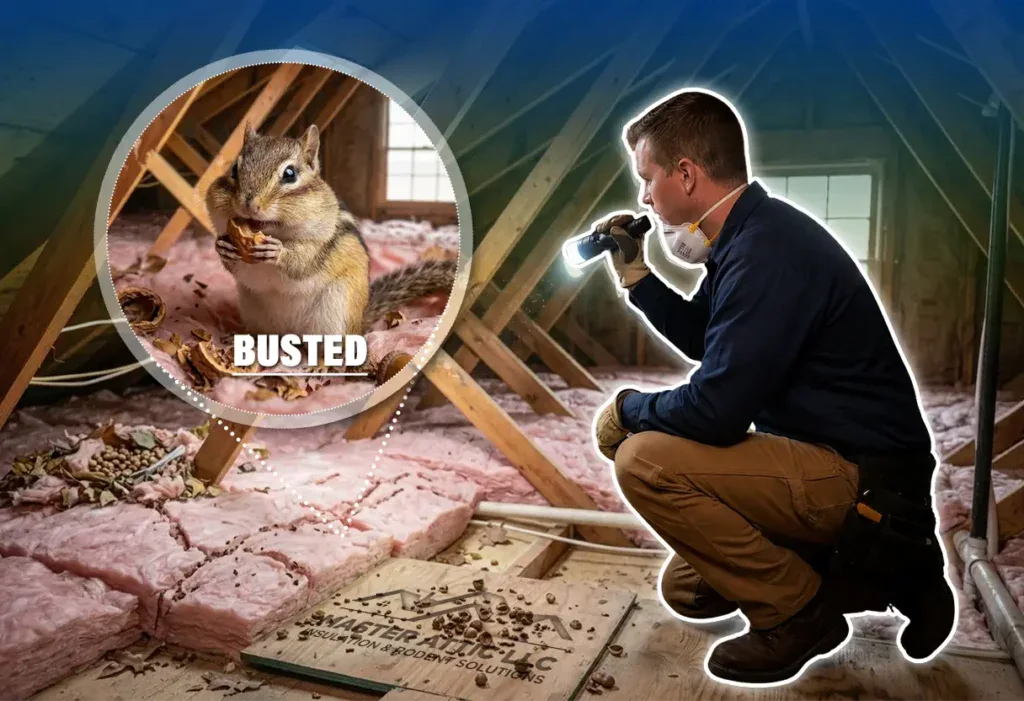
The trained and licensed professionals of Master Attic have been doing the work of attic and crawlspace restoration for residents of NJ and Pennsylvania for 20-plus years, removing every type of ‘creature’ that comes to like your attic space, or crawlspace, in a humane process to the creature and keeping safety and health central to the homeowners.
The following three steps are essential for effective pest management, in the attic or crawlspace, in particular, getting rid of chipmunks from the attic:
- Interior and Exterior Attic Inspection: Inspecting the attic for chipmunks requires assessing the interior damage indicative of a chipmunk infestation vs. that of mice or tree squirrels, and begins with listening for the rapid pattering and scratching heard during the day, along with any vocal high-pitched ‘chirping,’ and then inspecting for entry holes common to chipmunks. The next step in the interior inspection is to look for chipmunk nesting sites, shredded insulation, chipmunk food caches, and gnawed attic rafters, support beams, and chewed electrical wires.
- Exclusion: When all the evidence shows that the nuisance wildlife is that of a chipmunk infestation, the professionals of rodent proofing the attic will begin the step of wildlife exclusion. For chipmunk exclusion this entails humanely trapping the chipmunk in a cage trap and removing and moving the chipmunk far from the homeowner’s property before beginning an entry hole inspection. An entry point for tiny chipmunks can be as small as 1.5 to 2 inches wide. Trained professionals will examine and caulk small gaps or cover holes larger than ¼ inch with welded wire mesh that cannot be chewed. Foundation-level gaps are found by following burrows under decks, porches, and patios. Gaps are also sealed in roofline soffits and fascia boards. Any torn or chewed screens are repaired, and any chimney gaps are fixed with the installation of chimney caps.
- Chipmunk Control Techniques: With the inspection and exclusion process complete, the next important step is ensuring chipmunks do not return to the outside yard or the attic or crawlspace by eliminating the food and shelter cover these solitary creatures seek. Birdfeeders are moved far enough away from the house and tree branches are trimmed that overhang the roof of the house. Homeowners are advised to keep pet food indoors, place lids on trash cans, and pick up fallen fruit from the yard’s fruit trees and to clean up spilled birdseed on the ground or use pole-mounted feeders with seed-catching trays. The homeowner should also clear yard debris such as wood piles, rock mounds, and thick brush, as chipmunks often use this ‘cover’ when burrowing a nesting site. Keep the lawn mowed and shrubs and bushes trimmed. Consider repelling the chipmunk with strong scents the chipmunk dislikes: used coffee grounds, cayenne pepper, and mint in various garden pots. Cover the openings of gutter downspouts with sturdy wire screens so chipmunks cannot crawl inside, and cover gutters with gutter guards.
Contact The Pros of Wildlife Pest Management
Contact the pros who know how to get rid of chipmunks in the attic, which includes cleaning, sanitizing, and disinfecting! Master Attic technicians are trained in how to serve eviction notices to raccoons, squirrels, rats, mice, and bats, who like taking up residence in attics in New Jersey and Pennsylvania. In addition to rodent removal, Master Attic technicians ensure contaminated insulation caused by animals living in your attic is removed and replaced with new insulation. Master Attic also understands the importance of rodent-proofing the attic by identifying and sealing off entry points. Don’t wait, contact Master Attic or EEEE-mail us at info@masterattic.com.