

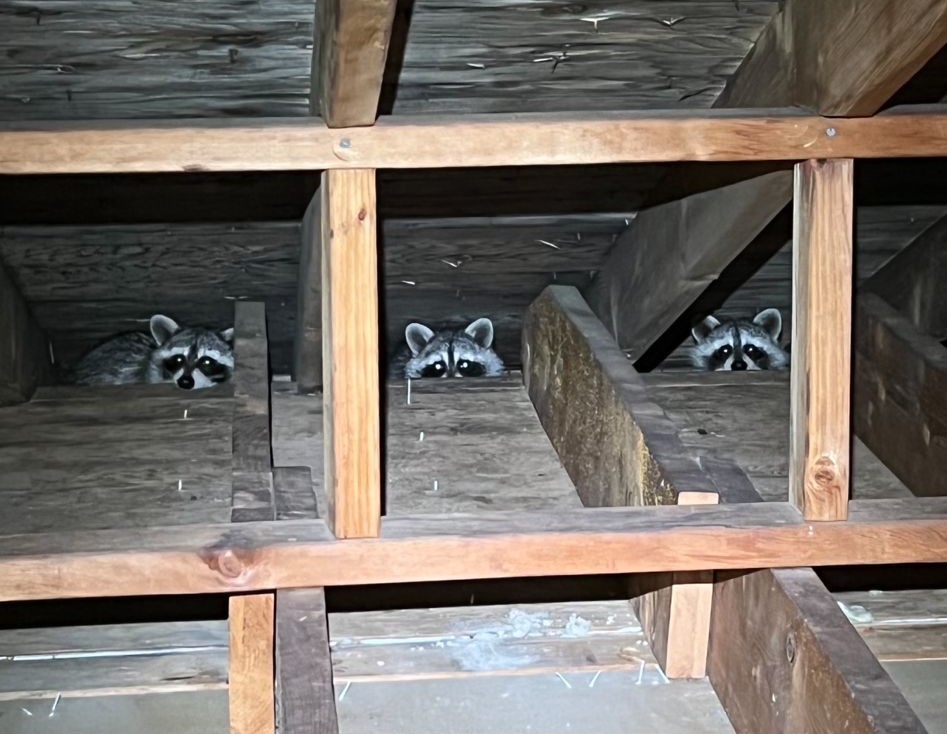
Heavy, slow thumping above the ceiling at night is the usual first sign that a raccoon has moved in. The safe way to get rid of raccoons in your attic is to have a professional do it. A raccoon is a strong wild animal that can carry rabies, it is often a mother guarding a litter, and the work happens on a roof and in a cramped attic. This guide explains how the job is done properly, what you can safely do yourself, and what to look for in the company you hire. Master Attic handles raccoon removal, entry point sealing and attic cleanup across New Jersey and eastern Pennsylvania.
Why Raccoon Removal Is Not a Do-It-Yourself Job
Most attic problems give a homeowner a choice between doing the work and hiring it out. This one does not, for five reasons:
Rabies. Raccoons are one of the main carriers of rabies in this part of the country. A cornered raccoon bites and scratches, and any bite means urgent medical care.
The droppings. Raccoon droppings can carry a roundworm that the CDC says can infect people and pets. Infections are rare but can be severe, and young children are most at risk.
A mother with babies. In spring and early summer the raccoon in an attic is very often a mother. She will defend her litter, and if she is removed or locked out without them, the young die in the attic.
The roof and the attic. The entry point is usually high on the roofline, and the den is in a dark space where one wrong step goes through the ceiling.
The law. New Jersey and Pennsylvania both restrict what can be done with a trapped raccoon, as covered below.
The steps that follow describe the work so you know what a complete job looks like and can tell whether the company you call is doing all of it.
Step 1: Make Sure It Is a Raccoon
This is the part you can do yourself, from inside the house and from the ground. Different animals need different fixes, and our guide on how to tell what animal is in your attic covers each one in detail. These are the signs that point to a raccoon:
The sound is heavy and happens at night. Raccoons are active after dark, and an adult sounds like something walking, not scurrying. Squirrels are busy in daylight, and mice make light scratching sounds.
The opening is large. From the ground, look for a torn soffit, a bent or missing roof vent cover, lifted shingles or an uncapped chimney. Raccoons often get in where building materials meet, such as the corner where a dormer joins the roof, and University of Nebraska wildlife specialists note they have been known to tear through a shingled roof to make a den in an attic.
You hear chattering or crying in spring. High-pitched chirping from one spot usually means a litter.
Inside the attic, a professional also looks for droppings piled in one place, called a latrine, and for wide, packed-down paths in the insulation. Leave that inspection to them.
Step 2: Find Out If There Are Babies
This is the step that separates a proper job from a bad one. Raccoons breed from January through March, and about nine weeks later the female gives birth to two to five young. That makes a raccoon in the attic in spring and early summer very likely to be a mother with a litter.
It matters because the babies cannot leave on their own. If the mother is trapped and taken away, or the opening is sealed while she is out, the young are left behind. A mother who is locked out will also tear a new hole in the roof to get back to them.
You can help by listening from the room below for chirping or whining, especially when the mother returns, and telling the technician what you heard and where. Humane World for Animals advises that when there is no rush, the kindest option is to wait until the cubs are old enough to leave with their mother, generally around 10 weeks old. When waiting is not practical, the mother and her young have to be removed together.
Step 3: The Humane Way to Get Rid of Raccoons in Your Attic
The goal is to get the whole family out by the same opening they used to come in, without separating them.
Making the Attic an Uncomfortable Den
A mother picks an attic because it is dark, quiet and safe. Take those three things away and she will often move her litter to another den by herself. Humane World for Animals describes using light, noise and smell together: attic lights left on from just before dusk, a loud radio, and a bowl of cider vinegar near the den, kept up for a few days. It is a push, not a fix. An attic that has not been sealed afterward is still open to the next animal.
One-Way Doors
A one-way door is fitted over an opening so a raccoon can push out but cannot get back in. It only works when every animal inside is able to walk out, and because it is hard to judge whether the young are mobile enough, Humane World for Animals says one-way doors are best left to wildlife professionals.
With raccoons, a one-way door is usually not the first choice. Experienced technicians generally remove the raccoons directly and close the openings once the attic is confirmed empty. A one-way exit door is the right tool in specific situations, for example when an animal cannot be reached during the removal visit and needs a way to leave without getting back in. Whichever method is used, the mother and her young should stay together.
What Should Never Be Done
Sealing the hole first. Closing an opening with animals still inside traps them in the house.
Poison. A raccoon that dies in an attic or a wall cavity leaves a far harder cleanup than a live one.
Smoke or fire in a chimney. Humane World for Animals warns never to use either one to drive animals out.
Going into the attic with a mother and her litter. She will defend them.
Trapping and Relocating: What New Jersey and Pennsylvania Allow
Many homeowners plan to trap the raccoon and drive it somewhere far away. Both states limit that, mainly because of rabies.
New Jersey. Property owners may control damage from raccoons by lawful means, but the Division of Fish and Wildlife relocation policy classifies raccoons as a rabies vector species and encourages fixing the cause, such as capping a chimney, so the animal can be released on site. When that is not possible, an adult raccoon has to be released within the township where it was caught, with the landowner's permission. In spring and summer the policy also calls for a search for newborns before any adult is moved, so the young stay with the mother.
Pennsylvania. The Pennsylvania Game Commission states that raccoons are a rabies vector species and should not be relocated like other wildlife. It asks landowners to contact their regional office before trapping nuisance wildlife, and it recommends sealing maternity dens in the fall, after the young have left.
Local rules can add to these. A company that does this work every week already knows them.
Step 4: Close Every Way Back In
Getting the raccoons out is half the job. An attic that was easy to enter once will be found again, which is the main reason raccoons keep coming back.
Before anything is sealed, the attic has to be confirmed empty. One common check is to stuff the opening loosely with wadded newspaper for two to three days. If the paper has not been pushed aside and the weather has not been cold or stormy, nothing is using the hole.
The opening is then closed with material a raccoon cannot pull apart:
Heavy wire mesh or metal flashing over holes in the roof, soffits and vents. Humane World for Animals recommends 16-gauge wire mesh.
A stainless steel cap on every chimney flue.
Galvanized hardware cloth over crawl space and foundation openings.
A thorough job covers the whole roofline, not only the hole the raccoon used. Roof vents, gable vents and the points where two roof sections meet are the usual weak spots, and tree limbs close to the roof act as a bridge. This sealing work is known as rodent proofing, and it blocks the openings raccoons and other animals use to get in.
Step 5: Clean Up What They Left Behind
Raccoon droppings should not be left in the attic, and they should not be swept up by the homeowner. The eggs of the roundworm they can carry take two to four weeks to become infectious, according to the CDC, so prompt removal lowers the risk, and the CDC stresses taking care not to contaminate hands and clothes while doing it. In an attic, where the droppings are mixed into the insulation, that is work for a cleanup crew.
A full cleanup after raccoons usually includes:
Removing insulation that is soiled, torn or packed flat.
Sanitizing the attic floor and framing to deal with what is left behind and with the scent that draws other animals.
Checking ducts and wiring. Raccoons tear flexible ductwork and chew wire insulation, and damaged wiring needs an electrician.
Installing new attic insulation once the space is clean and sealed.
What You Can Safely Do Yourself
Note when and where you hear the noise, and whether you hear babies.
Look for the entry point from the ground and take a photo of it.
Keep children and pets away from the attic and from any droppings.
Keep trash can lids tight and bring pet food in at night. As the New Jersey policy puts it, removing the animal without removing what attracted it means the problem continues.
Call a professional before the damage spreads.
What to Look For in a Raccoon Removal Company
Not every company that removes raccoons finishes the job. Some only take the animal away, which leaves the hole in the roof, the droppings and the damaged insulation exactly where they were. The next raccoon finds the same opening. Before you hire anyone, ask these questions:
Do they find every entry point? The inspection should cover the whole roofline, not only the obvious hole.
Do they check for a litter? A company that sets a trap without asking about babies is skipping the step that matters most.
Do they keep the mother and her young together?
Do they seal the entry points afterward, and with what? Removal without sealing is a short-term result.
Do they clean the attic and replace damaged insulation? If not, you will need a second contractor for the larger half of the work.
Are they licensed and insured, and is the work done by their own employees?
A general wildlife trapper answers the first few questions. A company that specializes in attics answers all of them, because removing the animal is only where its work begins.
That is how Master Attic works. Our licensed and insured technicians, hired and trained by us, find how the raccoons are getting in, remove the mother and her young together, block the entry points and restore the attic, from the insulation removal to the new insulation. We offer free estimates throughout New Jersey and eastern Pennsylvania.
Common Questions About Raccoons in the Attic
Can I remove a raccoon from my attic myself?
It is not recommended. Raccoons can be aggressive when they feel threatened and can carry rabies, a mother will defend her young, and both New Jersey and Pennsylvania limit what you may do with a trapped raccoon. Identifying the animal and securing your trash are the safe parts. Removal, sealing and cleanup are work for a professional.
How long will raccoons stay in an attic?
A mother with a litter stays until the young can travel with her, generally around 10 weeks after they are born. A raccoon without young may come and go, but do not count on it leaving for good while the opening is still there.
Will raccoons come back after they are removed?
They will try. Raccoons return to places where they have denned before, and the scent left in the attic attracts others. Sealing every entry point and cleaning the attic is what stops the cycle.
How much does raccoon removal cost?
It depends on how the raccoons got in, whether there is a litter and how much damage they did to the insulation. Our post on what goes into the cost of raccoon removal explains the factors, and a free estimate covers your attic specifically.